|
THE HISTORY and DEVELOPMENT
of LASER ENGINES
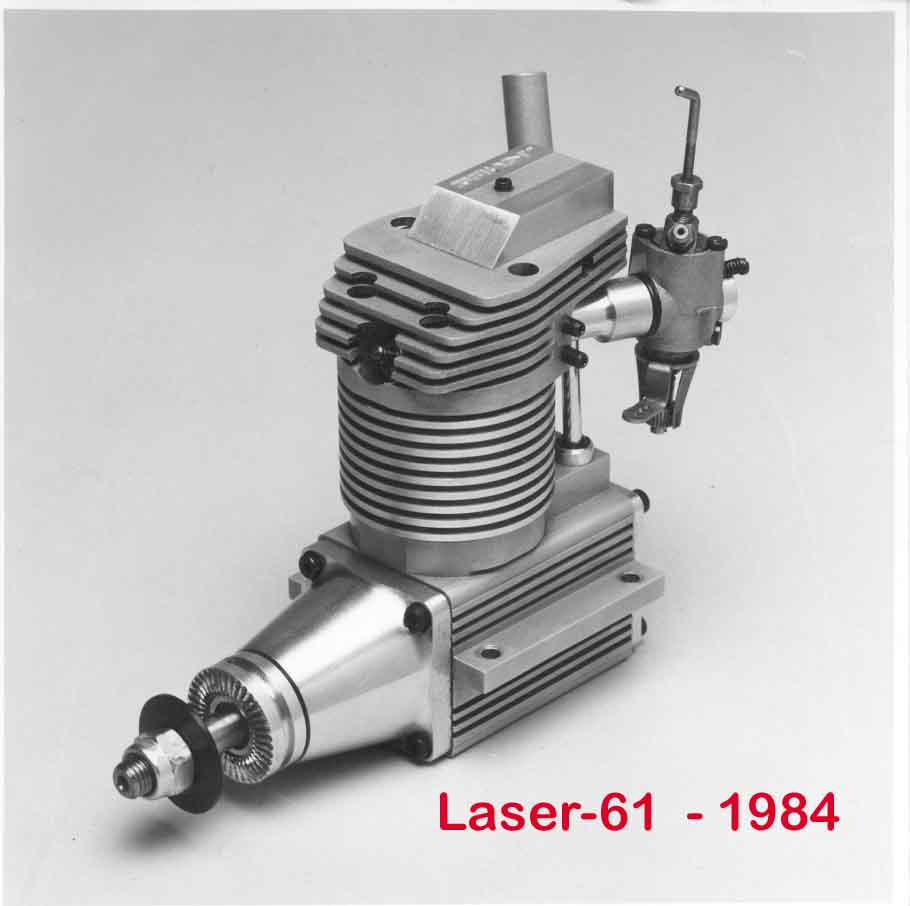
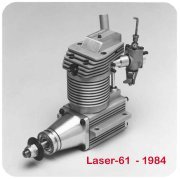
The first Laser-61
engine ran in April 1983 following many months of research into
both full size and model engines. The engine was designed by Neil
Tidey, a lifetime modeller with experience in engineering and marketing.
This engine proved
to be the most powerful 61 4-stroke ever produced with an output
of 1.2bhp @ 14,000rpm using fuel containing 10% nitromethane. Due
to the increase in power a small silencer was fitted as standard.
With the aid of a Government
grant the Laser-75 and 120v twin were developed to complete the
initial range of engines, AGC Sales Ltd. was formed and full production
commenced in 1984.
The 61 was fitted into
a Chris Foss Wot-4 and flown at Sandown which is the major U.K.
trade show. This was the first time a 4-stroke engine had been demonstrated
for performance. The days when the 4-stroke engine was considered
a novelty , very quiet and ideal for slow flying ‘Vintage’ type
models was gone! A Laser-120v was demonstrated in a 1/4 scale Flair
Triplane.
The Laser-90
and 150v twin were introduced in 1985. Brian Taylor used a Laser-75
to win the 1985 British National Championships which began the
domination of Laser
engines in FAI Scale competitions. A Laser-75 and a 90 were used
to power the prototype 1/4 scale D B Pup and the new Chris Foss
‘Acrowot’ was powered by a Laser-75.
The Laser-45 was introduced
in 1986.
Peter McDermott used
a Laser-90 to become European scale champion in 1987. Two prototype
180v twins were produced following the success of the Laser-150v
twin and fitted into the Stranraer Flying boat built by Dr Jeremy
Shaw for flight proving. The engines proved highly reliable, very
smooth running and powerful.
New CNC machinery was
introduced in 1988 and the cylinder liners were manufactured from
brass and chrome plated, replacing the cast iron or steel liners.
For additional reliability a second piston ring was added. The Laser-45
was replaced by the Laser-50. The silencer became a one piece welded
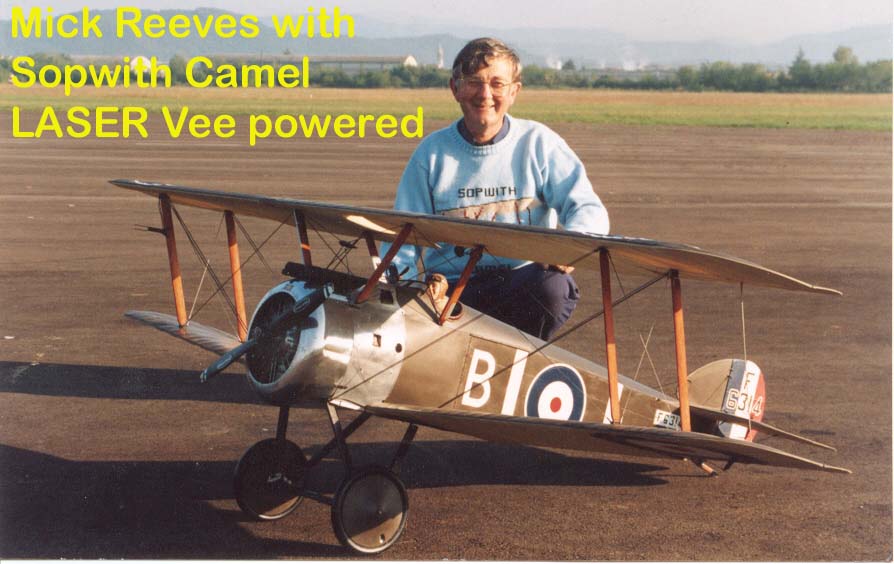
unit. Mick Reeves came 6th. in the World Championships using a Laser-180v.
In late 1989 the Laser-62
was introduced, based on the original Laser-45. The cylinder head
on the 75 and 90 was modified to increase the size of the inlet
valve.
The Super Tigre carburettor
was fitted with a new ratchet main needle in 1990, replacing the
wire type. The ‘Quiet’ silencer was developed and offered as
an option on all engines.
The Laser-50 was discontinued.
The Laser-150 was designed
to compete with the new Japanese 120 engines. Only the aerobatic
rules demanded a maximum capacity of 20cc (120), as the scale rules
allowed unlimited engine capacity, power to weight ratio was more
important than specific power output. The decision was made to produce
a 150 single with high torque to run at 8,000 - 9,000rpm rather
than 11-12,000rpm of the new 120 engines. This would result in higher
reliability and ease of use. The 150 was designed and developed
in 1991, the resultant engine being smaller and lighter than the
existing 120 engines. The design allowed the development of a short
stroke, very compact 120.
Peter McDermott won
the World FAI Scale Championships in 1992 with Mick Reeves placing
4th. Both used Laser-180v engines. Production of the Laser-150 started
in 1992..
In 1993 the 62, 75,
90, 150v and 180v engines were discontinued and replaced by the
Laser-70, 80, 100, 160v and 200v.
The uprated engines
incorporated the new features of the Laser-150 single. The cylinder
head with hardened steel rockers, valves and collets was introduced.
The carburettor and silencer fixings were changed from screws to
a special clip and the glow plug was placed vertical to make connection
easier. The crankcases were strengthened and fully nitride hardened
high tensile steel crankshafts were introduced. The engine was fitted
with a larger version of the Laser ’Quiet’ silencer.
The ‘Quiet’ silencer
was made standard on all engines as part of our commitment to noise
reduction.
The Nickel Silicon
Carbide electro plated cylinder was introduced to the Laser-150
in early 1993 to reduce weight and give improved cooling. This plating
is very thick and formed direct onto the aluminium eliminating the
need for a steel cylinder to back the plating. Due to the high cost
it was initially offered as an option but was made standard by the
end of the year.
Export sales of Laser
engines increased as a result of competition success and the engines
were used by more top scale modellers at the World Scale Championships
at Deelan in the Netherlands in 1994. The Laser-300v was introduced
following development the previous year and the prototype 120 single
and 240v were produced. To further improve lubrication the second
ring on the Laser-150 and 300v was modified to make the ring an
oil control ring. This was introduced on production engines from
August 1994.
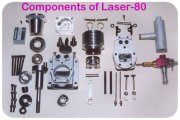
The short stroke 120
single was introduced in 1995. This exceptionally compact and lightweight
engine with a high power to weight ratio does is shorter than any
91 4-stroke engine and more powerful. A new carburettor to our specification
was introduced in August 1995 for the 120, 150 and 300v engines.

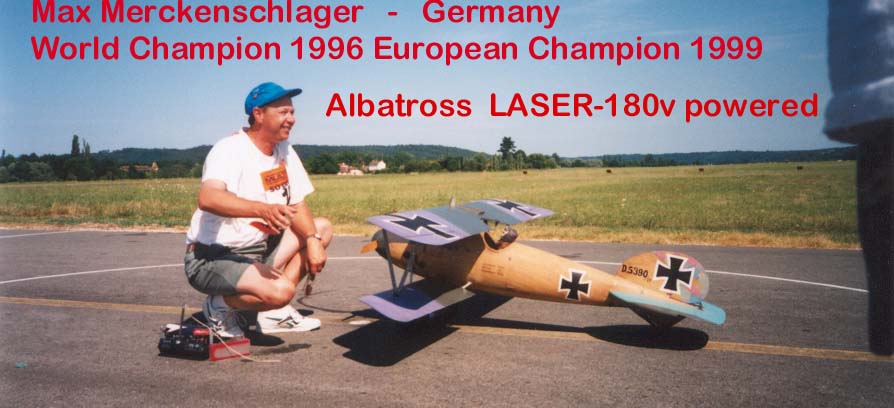
Max Merckenschlager
of Germany won the 1996 World FAI 3c Championships held in Peregeaux,
France with his Laser powered Albatross. Laser engines again dominated
the event.
Production of the Laser
240v was commenced in 1996. This engine is exceptionally compact
and has a very high power to weigh ratio. It is designed to for
F3A aerobatics. Due to the very compact size, good cooling is very
important to prevent overheating.
The Nickel Silicon
Carbide plated cylinder was introduced to the Laser-100 and 200v
in 1997.
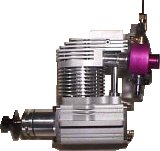
The Laser-70 and 80
were fitted with the Nickel Silicon Carbide cylinder in 1998. Credit
Card payment facilities were introduced and production increased
to allow engines to be normally available from stock. In South Africa
at the World Scale Championships 17 out of 46 competitors used Laser
engines and 9 out of the first 11 placed models were Laser powered.
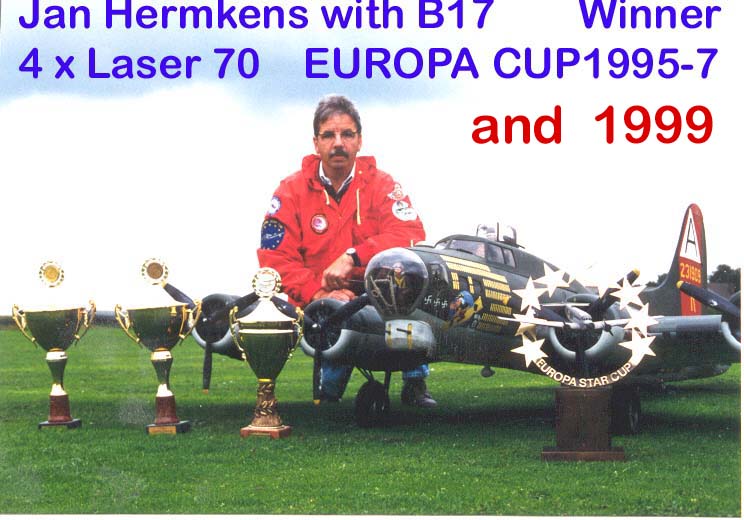
Laser engines powered
the first three placed models in the 1999 European Scale championships
and 14 out of the 32 competitors used Laser engines.
The reputation and success of
Laser engines is built on quality and in 1999 this will continue......
Manufactured in the U.K
by
| AGC Sales Ltd. |
| London Road |
| Apsley |
| Hemel Hempstead |
| Herts. HP3
9ST |
| Tel:
+44 (0)1525 210596
Fax +44 (0)1442 233332 |
|