|
SPECIFICATIONS
Inclined OHV pushrod design operated from rear of engine. Wedge
shaped cylinder with vertical plug. Twin camshafts. Hardened stainless
steel valves. Separate replaceable valve guides. All valvegear is
fully hardened steel. Twin piston rings for compression and oil
control. Aluminium parts fully machined from solid internally and
externally, polished or bead blasted finish.
| LASER |
70 |
80 |
100 |
120 |
150 |
180 |
160V |
200v |
240V |
300v |
| Bore
mm |
27.7 |
27.7 |
27.7 |
33.5 |
33.5 |
33.5 |
27.7 |
27.7 |
33.5 |
33.5 |
| Stroke
mm |
18.8 |
22.2 |
26.9 |
22.2 |
26.9 |
33.3 |
22.2 |
26.9 |
22.2 |
26.9 |
| Weight
grm |
560 |
645 |
770 |
785 |
835 |
1200 |
1050 |
1160 |
1160 |
1660 |
| Propeller |
12x8 |
14x7 |
15x8 |
15x8 |
16x8 |
18x8 |
16x8 |
18x6 |
14x14 |
20x8 |
| Height
from crankshaft |
|
|
|
|
|
|
|
|
|
|
| to
cylinder head |
84 |
92 |
100 |
93 |
101 |
114 |
92 |
100 |
93 |
101 |
| Width
between |
|
|
|
|
|
|
|
|
|
|
| engines
bearers |
35 |
40 |
45 |
45 |
45 |
57.15 |
Backplate
mount on vees
|
| Crankshaft
thread |
1/4x28unf |
M8 |
M8 |
M8 |
M8 |
M10 |
M8 |
M10 |
M10 |
M10 |
| Engine
built before 2002 will have unf crankshaft threads |
FUEL
15%
oil preferably full synthetic 85% methanol. Nitromethane may be
added up to 12% for increased performance. Most standard commercial
fuels will give satisfactory performance.
PLEASE PHONE IF
YOU NEED ADVICE TO SELECT THE CORRECT ENGINE FOR YOUR MODEL
Power
output is one of the key factors of the success of LASER ENGINES.
 Design features such as the straight gas flow from the carburetor
improve performance and follow full size practice. They are designed
to give high torque enabling large efficient propellers to be used
reliably. This also reduces noise and increases the life of the
engine. The NITROMETHANE is not needed for normal running but will
significantly increase performance. Nitromethane is very expensive
and the major cause of corrosion. Power figures can be highly misleading
as they depend on many factors including nitromethane content in
the fuel and the speed the engine achieves maximum power. Laser
engines let competition results show performance and do not publish
power figures. LASER ENGINES are designed for the serious modeler
who demands power with reliability and an engine with exceptional
life.
Design features such as the straight gas flow from the carburetor
improve performance and follow full size practice. They are designed
to give high torque enabling large efficient propellers to be used
reliably. This also reduces noise and increases the life of the
engine. The NITROMETHANE is not needed for normal running but will
significantly increase performance. Nitromethane is very expensive
and the major cause of corrosion. Power figures can be highly misleading
as they depend on many factors including nitromethane content in
the fuel and the speed the engine achieves maximum power. Laser
engines let competition results show performance and do not publish
power figures. LASER ENGINES are designed for the serious modeler
who demands power with reliability and an engine with exceptional
life.
LASER-70
Exceptionally compact and light, similar height to other 48 - 52
4-stroke engines. Best power range 9-10,500rpm static. Ideal for
sports aerobatic models and multi engine models. where power to
size ratio and reliability are important.
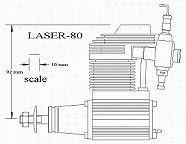
LASER-80
similar height to other 65-70 4-strokes. Wide useful power range
from 8-10,500rpm. A direct replacement for the very popular Laser
75 fitting the same mounting but giving greater power.
LASER-100
Long stroke engine giving huge torque at low speeds for large propellers.
Useful power range 7,500-9,000rpm. Ideal for the larger scale model
and exceptionally quiet at low propeller speeds.
LASER-120
Very compact engine shorter than any production 90 4-stroke engine.
Not as powerful as other 120 4-stroke engines but will fit into
small cowls. Useful power range 8-9,500rpm. Always use the LASER-150
if a 120 is called for.
LASER-150
Lighter and shorter than any 120 4-stroke but with more torque.
Useful power range 8-9,500rpm. Our best selling engine, powerful,
reliable, ideal for sport and scale models with proven international
competition success.
LASER-180
The Laser-180 single is a long stroke engine providing high torque at
low speed. It will pull up to a Classic Master 20 x 6 propeller at over
7,000rpm. The engine is ideal for the larger scale model. It is ideal for
models such as the Flair Stearman and Tiger Moth and WW2 type aircraft where
a Classic Master 18 x 8 propeller can be used.No attempt has been made to
lighten the engine as these models will need the weight of the engine in the
nose. It is not suitable for the lightweight aerobatic models such as the Giles,
Extra Cap where the additional weight compared to the Laser-150 would be a disadvantage.
The Laser-180 has proved to be an exceptionally reliable and easy to operate engine with
tremendous pulling power due to the larger propellers. The low speed gives a very
realistic sound and the vibration levels are low.
LASER
Vee Twins. The Vee twins are exceptionally
smooth running very powerful and reliable. The Vee layout gives
perfect primary balance and the offbeat firing gives the engine
a distinctive and realistic sound. The smooth power of the Vee twin
puts less vibration and stress into your model and radio gear resulting
in longer life and lighter airframe structures.
LASER-160v
A compact engine with a wide power band between 8-9,500rpm.
LASER-200v
The most successful competition 4-stroke twin ever produced.
Will fit easily into scale radial cowls and in Continental and Lycoming
cowls. The engine gives best power between 8-9,000rpm.
LASER-240v
Smaller
but similar weight to the 200v the engine is designed for FAI aerobatics.
The engine has the highest power/weight ratio of all Laser engines.
Due to the small size it is essential that good cooling is arranged
in the model, it is not as tolerant as the 200v.
LASER-300v
Designed
for the larger model, the 300v is the most powerful in the Laser
range. Performance between 7,500 and 9,000rpm. it has excellent
running qualities and will suit the new 12Kgs FAI rules.
|